
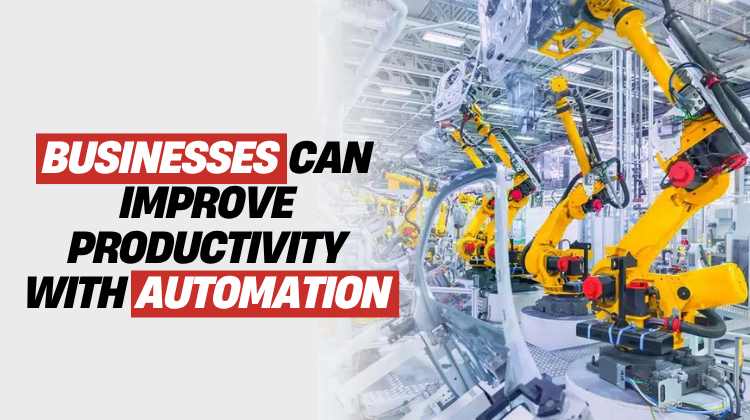
How Businesses Can Improve Productivity with Automation
Businesses Can Improve Productivity with Automation
In today’s fast-paced and highly competitive business environment, productivity is one of the most important factors that determine long-term success. Companies are constantly searching for ways to reduce costs, improve efficiency, and deliver better products and services without compromising quality. One of the most effective solutions helping businesses achieve these goals is automation.
Business automation refers to the use of technology to perform repetitive tasks and streamline workflows with minimal human intervention. From manufacturing and logistics to finance, marketing, customer service, and human resources, automation is transforming nearly every aspect of modern business operations. By automating routine processes, organizations can increase productivity, reduce operational costs, minimize human error, and allow employees to focus on strategic and value-driven activities.
As technologies such as Artificial Intelligence (AI), Machine Learning, Robotic Process Automation (RPA), and cloud computing continue to evolve, automation is becoming more intelligent, affordable, and accessible for businesses of all sizes.
Understanding Business Automation
Business automation involves using software, machines, or digital systems to perform tasks that would otherwise require manual effort. These tasks can range from simple activities such as sending invoices and scheduling meetings to more advanced processes like analyzing customer data, managing supply chains, or operating robotic production lines.
>The goal of automation is not to replace employees but to eliminate repetitive work, improve operational consistency, and create more efficient business processes. When implemented correctly, automation enables organizations to accomplish more with the same resources while maintaining high standards of quality and accuracy.
Reducing Repetitive Manual Work
One of the greatest advantages of automation is its ability to handle repetitive and time-consuming tasks. Employees often spend a significant portion of their workday on administrative responsibilities such as entering data, processing invoices, updating spreadsheets, responding to routine emails, or scheduling appointments.
Automation software can perform these activities quickly and accurately, freeing employees to focus on problem-solving, innovation, customer engagement, and strategic planning. This shift not only improves productivity but also increases employee satisfaction by reducing monotonous workloads.
Increasing Accuracy and Reducing Human Error
Manual processes are naturally susceptible to mistakes, especially when employees perform repetitive tasks under pressure or tight deadlines. Errors in financial records, inventory management, customer orders, or compliance documentation can lead to costly consequences.
Automation improves consistency by following predefined rules and standardized procedures. Automated systems perform calculations accurately, process transactions efficiently, and maintain detailed records without the inconsistencies often associated with manual work.
Greater accuracy also enhances customer satisfaction by reducing delays, improving service quality, and minimizing operational disruptions.
Improving Customer Service
Customer expectations have changed significantly in recent years. Modern consumers expect fast responses, personalized experiences, and support that is available around the clock.
Automation helps businesses meet these expectations through AI-powered chatbots, automated email responses, self-service portals, and intelligent customer relationship management (CRM) systems. These tools can answer frequently asked questions, process orders, provide updates, and resolve common issues without requiring immediate human intervention.
By automating routine customer interactions, support teams can dedicate more time to handling complex inquiries and building stronger customer relationships.
Enhancing Workflow Efficiency
Many business processes involve multiple departments working together. Delays often occur when approvals, document transfers, or communication depend on manual coordination.
Workflow automation ensures that tasks move automatically from one stage to another based on predefined conditions. Documents can be routed for approval, notifications sent instantly, and deadlines tracked without constant follow-up.
This streamlined approach reduces bottlenecks, accelerates project completion, and improves collaboration across departments.
Supporting Better Decision-Making
Automation technologies collect valuable business data throughout daily operations. Combined with AI-powered analytics, this information provides managers with real-time insights into productivity, sales performance, customer behavior, inventory levels, and operational efficiency.
Instead of relying solely on historical reports or assumptions, business leaders can monitor key performance indicators through interactive dashboards and predictive analytics. These insights enable faster, more informed decisions that improve profitability and operational performance.
Data-driven decision-making also helps organizations identify inefficiencies before they become significant problems.
Optimizing Inventory and Supply Chain Management
Managing inventory manually can be both time-consuming and error-prone. Overstocking increases storage costs, while stock shortages can lead to missed sales opportunities and dissatisfied customers.
Automation systems monitor inventory levels in real time, generate purchase orders automatically, track shipments, and forecast future demand using historical data. Businesses can maintain optimal inventory levels while reducing waste and improving supply chain efficiency.
For manufacturing and retail companies, automated inventory management contributes significantly to productivity and customer satisfaction.
Increasing Employee Productivity
Contrary to common misconceptions, automation is not designed to replace employees entirely. Instead, it enables workers to focus on responsibilities that require creativity, critical thinking, leadership, and interpersonal communication.
When repetitive administrative tasks are automated, employees have more time to develop innovative ideas, strengthen customer relationships, solve complex business challenges, and contribute to organizational growth.
Businesses that combine automation with employee development often experience higher engagement, improved morale, and stronger overall performance.
Reducing Operational Costs
Although implementing automation requires an initial investment, the long-term financial benefits are substantial. Automated systems reduce labor-intensive processes, minimize costly errors, improve resource utilization, and increase overall efficiency.
Businesses can process more work without proportionally increasing staffing costs, allowing organizations to scale operations more effectively while maintaining profitability.
Automation also reduces downtime by improving process reliability and enabling proactive maintenance through intelligent monitoring systems.
Preparing for the Future of Business
As digital transformation accelerates, automation will continue to play an increasingly important role in business success. Emerging technologies such as Artificial Intelligence, Machine Learning, Robotic Process Automation, and the Internet of Things (IoT) are creating new opportunities for intelligent automation across industries.
Companies that invest in automation today are positioning themselves to respond more quickly to changing market conditions, improve customer experiences, and remain competitive in an increasingly technology-driven economy.
However, successful automation requires careful planning.
Organizations should evaluate their business processes, select technologies that align with their goals, provide adequate employee training, and continuously monitor performance to maximize return on investment.