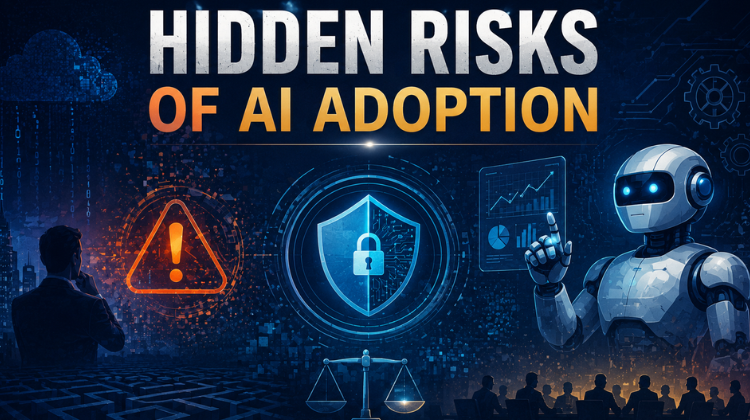
The Hidden Risks of AI Every Business Should Understand
Artificial Intelligence (AI) has become one of the most influential technologies shaping modern businesses. From automating repetitive tasks and improving customer service to enhancing data analysis and decision-making, AI is helping organizations increase efficiency and remain competitive. Businesses across industries are investing heavily in AI-powered solutions to streamline operations and drive innovation.
However, while the benefits of AI are widely discussed, its potential risks often receive less attention. Like any powerful technology, AI presents challenges that businesses must understand before integrating it into their operations. Ignoring these risks can lead to financial losses, reputational damage, legal complications, and operational disruptions.
Understanding both the opportunities and the limitations of AI allows businesses to adopt the technology responsibly while minimizing potential threats. Here are some of the hidden risks every business owner should be aware of.
1. Data Privacy and Security Risks
AI systems rely heavily on data to learn, analyze, and make decisions. Many AI applications process sensitive customer information, employee records, financial data, and confidential business documents. If this data is not properly protected, it becomes vulnerable to cyber attacks, unauthorized access, or accidental exposure.
Businesses using AI must implement strong cyber security measures, encrypt sensitive information, and comply with applicable data protection regulations. Customers are increasingly concerned about how their personal information is collected and used, making data privacy an essential component of responsible AI adoption.
2. Inaccurate or Misleading Results
Although AI can analyze enormous amounts of information quickly, it is not always correct. AI models occasionally generate inaccurate responses, outdated information, or fabricated facts, often referred to as “AI hallucinations.” When businesses rely solely on AI-generated content or recommendations without human verification, costly mistakes can occur.
For example, incorrect financial analysis, misleading product descriptions, or inaccurate customer communications can damage credibility and reduce customer trust. Human oversight remains essential whenever AI is used for important business decisions.
3. Cyber security Threats Are Becoming More Advanced
Ironically, while AI strengthens cyber security defenses, cybercriminals are also using AI to launch more sophisticated attacks. AI-generated phishing emails, deep fake videos, automated malware, and intelligent hacking techniques have become increasingly difficult to detect.
Businesses must recognize that AI has created a new generation of cyber threats. Investing in modern security solutions, employee awareness training, and continuous monitoring is becoming increasingly important to defend against AI-powered attacks.
4. Overdependence on Artificial Intelligence
As AI tools become more capable, some organizations begin depending on them for nearly every business function. While automation improves efficiency, excessive reliance on AI can reduce human involvement in decision-making and problem-solving.
Business leaders should remember that AI is designed to support—not replace—human judgment. Strategic planning, ethical decisions, customer relationships, negotiations, and crisis management still require human experience, creativity, and emotional intelligence. Maintaining the right balance between automation and human expertise is essential for sustainable success.
5. Bias in AI Decision-Making
AI systems learn from the data used to train them. If that data contains historical bias or incomplete information, AI may unintentionally produce unfair or discriminatory outcomes. This can affect hiring decisions, loan approvals, customer recommendations, or performance evaluations.
For businesses, biased AI systems can create legal risks and damage public trust. Organizations should regularly review AI-generated decisions, test systems for fairness, and ensure that diverse and representative data is used during development and implementation.
6. Legal and Regulatory Challenges
Governments around the world are introducing new regulations governing the use of AI, data privacy, intellectual property, and consumer protection. Businesses using AI without understanding these legal requirements may face compliance issues, financial penalties, or legal disputes.
Organizations should stay informed about evolving AI regulations and establish internal policies that ensure responsible technology use. Consulting legal experts before implementing AI in critical business processes can help reduce future risks.
7. Job Displacement and Workforce Concerns
AI automation is changing the nature of work by reducing the need for certain repetitive tasks. While AI creates new opportunities for innovation and productivity, it may also generate concerns among employees about job security.
Businesses should approach AI implementation thoughtfully by investing in employee training and upskilling programs. Rather than replacing workers entirely, organizations can use AI to automate routine activities while enabling employees to focus on creative, strategic, and customer-focused responsibilities.
Supporting workforce development helps businesses retain valuable talent and encourages employees to embrace technological change rather than fear it.
8. High Implementation Costs and Integration Challenges
Although AI solutions have become more affordable, implementing them successfully still requires investment in software, infrastructure, employee training, and ongoing maintenance. Smaller businesses may underestimate these costs or expect immediate returns.
Additionally, integrating AI with existing business systems can be technically challenging. Poor planning may result in operational disruptions or underutilized technology. Organizations should carefully evaluate their objectives, budget, and technical readiness before adopting AI solutions.
9. Ethical Concerns and Customer Trust
Customers increasingly expect businesses to use AI responsibly and transparently. If organizations fail to disclose AI-generated content, misuse customer information, or make decisions without proper accountability, public trust can quickly decline.
Ethical AI practices include transparency, fairness, accountability, and responsible data usage. Businesses that openly communicate how AI supports their services while maintaining human oversight are more likely to build lasting customer confidence.
Building a Responsible AI Strategy
Successfully adopting AI requires more than simply purchasing advanced software. Businesses should develop a comprehensive AI strategy that includes employee training, cybersecurity measures, ethical guidelines, regulatory compliance, and ongoing performance monitoring.
Regularly evaluating AI systems ensures they continue producing accurate, reliable, and unbiased results. Combining AI with experienced human professionals allows organizations to maximize efficiency while minimizing potential risks.
Companies should also encourage continuous learning as AI technology evolves rapidly. Staying informed about new developments enables businesses to adapt responsibly and maintain a competitive advantage.