
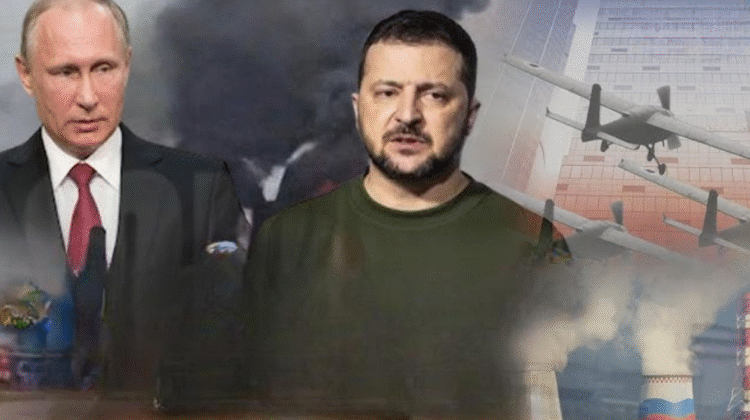
RUSSIA ACCUSES UKRAINE OF ATTACKING NUCLEAR PLANT, CAUSING A FIRE
On August 24, 2025, Ukrainians celebrated the country’s 34th Independence Day when tensions intensified as Russia blamed Ukraine for a drone attack on the Kursk Nuclear Power Plant—the incident precipitated a fire Moscow claims and which resulted in a drastic decrease in the capacity of the reactor to operate. The accusation fueled already seething fears of military attacks around nuclear plants in an already unstable area.
The Alleged Strike: Fire, No Radiation, and Reduced Capacity;
Russian officials reported that a Ukrainian drone hit an auxiliary transformer at the Kursk power plant, igniting a fire. Although the fire was quickly extinguished, it resulted in a 50 percent decrease in the operating capacity of Reactor No. 3. Notably, no one was injured, and no radiation leak occurred, a fact later confirmed by the International Atomic Energy Agency (IAEA).
Russian air defenses are said to have downed 95 Ukrainian drones in different areas, including others at energy infrastructure and the port of Ust-Luga. Concurrently, Ukraine stated that it had thwarted a salvo of 72 Shahed drones and decoys, destroying or jamming 48 of them.
A Symbolic Moment Amid Independence Day Celebrations;
The fact that the strike came on Ukraine’s Independence Day celebrations lent it an added symbolic value. President Volodymyr Zelenskyy, addressing from Kyiv’s Independence Square, left a defiant message: “We are building a Ukraine strong enough to live in security and peace,” and appealed for a “just peace” to be negotiated on equal terms.
High-level diplomatic efforts overlapped with these developments. Canadian Prime Minister Mark Carney was in Kyiv and reconfirmed Canada’s unwavering support. Moreover, Norway promised major new air defense assistance, and Western diplomats, including an American envoy, participated in the national commemorations.
Ukraine and Russia also conducted a prisoner swap, releasing 146 people on each side.
Strategic Escalation Along Nuclear Frontiers;
This accident fits into a larger trend of nuclear-related accidents during the war. Earlier in February 2025, Ukraine blamed Russia for conducting a drone attack on the Chernobyl New Safe Confinement, which damaged the protection shelter, although the level of radiation remained normal. Russia denied carrying out the attack, calling it provocation; the IAEA did not place blame.
Likewise, the Zaporizhzhia Nuclear Power Plant, Europe’s biggest, has been contentious. Through August, both sides accused each other of shelling, provoking concern at the United Nations about the danger of a nuclear disaster.
Interpretation and Implications;
Russia’s account presents the strike on Kursk as a rash provocation, an assault on international agreements on nuclear safety. Governor Alexander Khinshtein characterized the attack as an existential threat.
For Ukraine, no direct statement was made on the Kursk incident, but Zelenskyy’s words echo a wider theme: resilience, sovereignty, and refusal to be cast as aggressor or victim.
Western responses have framed the episode as a stark reminder of the danger involved in military maneuvers close to nuclear installations. Security experts caution that tensions increase the danger of miscalculation that may lead to catastrophe.
Looking Ahead: Diplomacy, Security, and the Nuclear Issue;
Thanks to IAEA intervention, the Kursk accident—while not leading to release of radiation—emphasizes the thin safety margins at nuclear plants trapped in the middle of war. Diplomatic initiative towards defusing tensions and greater monitoring appears more imperative than ever.
In spite of continued hostilities, independent diplomats and mediators persist in calling for nuclear safety zones, neutral inspections, and binding restraint accords—highly necessary as the war continues to develop, with nuclear facilities growing ever more a target and a symbol.