
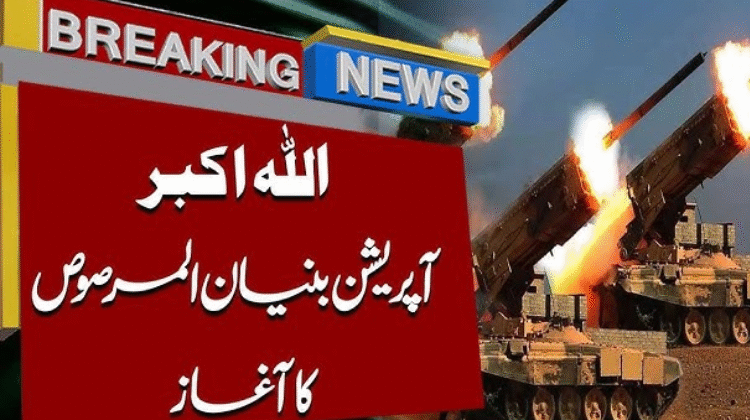
Operation Bunyan-un-Marsoos: Pakistan counters India’s Operation Sindoor
India-Pakistan Tensions and Pakistan’s Response – A Summary
Recently, tensions between India and Pakistan increased after a deadly attack in Pahalgam, located in Indian Illegally Occupied Jammu and Kashmir (IIOJK), on April 22. In the attack, 26 people were killed. India blamed Pakistan-based groups, but no proof was given. Pakistan denied the claim strongly.
Following the incident, on April 23, India took several harsh steps. It closed the Wagah border, cancelled visas for Pakistanis, and suspended the Indus Waters Treaty, an important agreement about sharing river water. Pakistan called these actions an “act of war” and closed the border from its side in response.
The situation worsened quickly. On May 6–7, India launched a military attack on Pakistan. This became the most serious military clash between the two countries in many years. Many people died on both sides. However, the fight was eventually stopped due to diplomatic efforts, and both countries agreed to halt all military activities.
Despite Pakistan’s warnings, India kept provoking. Indian drones entered Pakistani airspace several times, and their media kept pushing war-like messages. Finally, Pakistan responded with full force.
Key Moments and Achievements for Pakistan
Night of May 6–7
Pakistan Air Force made history by winning a BVR (Beyond Visual Range) air battle. They shot down five Indian fighter jets—three Rafale, one SU-30, and one MiG-29—without losing any aircraft. Pakistani officials called it a “100–0” victory.
May 7
Pakistan stopped a large drone attack. It destroyed 78 armed drones made in Israel, including Heron and Harop types. Later that night, an Indian missile was also shot down near Dinga in Punjab.
Night of May 8–9
Pakistan’s air defence successfully stopped several BrahMos supersonic missiles. This showed the strength of its radar and missile systems.
During the conflict
Pakistan replied strongly to Indian strikes. Reports said that Pakistan hit 26 military targets inside India, in response to attacks on seven Pakistani locations. Pakistani forces also destroyed Indian army headquarters near the Line of Control.
Fateh-1 Missile System
Pakistan used its Fateh-1 guided rockets during the battle. Officials said these locally-made missiles caused serious damage to Indian airbases and support areas. The system worked well in real combat.
Diplomatic and Financial Strength
Even during the conflict, Pakistan secured a $1 billion IMF deal, showing international support. China and Turkiye publicly supported Pakistan, while the U.S. and Western nations stayed neutral. Only Israel clearly supported India.