
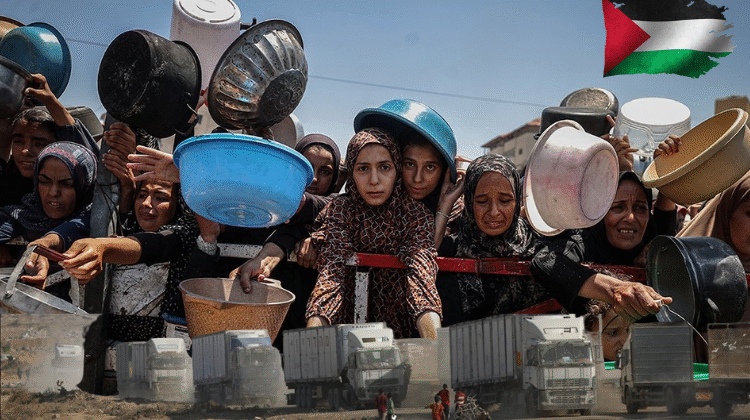
At least 560 tons of food come into Gaza every day, but that’s still not enough.
The World Food Program (WFP) says that since the ceasefire between Israel and Hamas went into effect, an average of 560 tons of food have been coming into the Gaza Strip every day. This number is a clear increase from when there was heavy fighting, which made it very hard to get aid to people. Even with the ceasefire, humanitarian groups say that this amount is not enough to stop mass hunger and famine from spreading across much of Gaza.
Opportunities in the face of limitations
The ceasefire has opened up a small but important window for aid groups to get deeper into Gaza than they could before. WFP officials say they are working quickly to increase food aid by giving out staples like wheat flour, ready-to-eat meals, and family food parcels. They have also started to help more bakeries in the last few days. The goal is to make it easier for people in the enclave to get fresh bread. At the same time, the WFP has started or expanded cash-based transfers so that families in need can buy food from working markets.
But there are big logistical problems that make the positive movement less strong. Important border crossings, especially in northern Gaza, are still closed or tightly controlled, which makes it hard for food aid to get directly to the areas that need it the most. Aid convoys that get to southern and central Gaza have to deal with broken roads, debris, and blocks, which makes it slow, patchy, and dangerous to distribute the aid. Reports say that on one recent day, 57 trucks entered southern and central Gaza. This is a welcome step forward, but it is still not enough to provide meaningful relief, as the estimated need is 80–100 trucks per day.
The cost of limited access in northern Gaza
Many communities in northern Gaza have been completely cut off from long-term aid, making it the worst food crisis. The closure of important routes like Zikim has made it even harder to deliver food to places like Gaza City, where people are starving. Even when nutrition products, like therapeutic foods for kids, do get to northern neighborhoods, they are usually in short supply and have even more movement restrictions.
Before the current ceasefire, the WFP publicly said that all of its food stocks in Gaza were gone after a long blockade. This meant that community kitchens and bakeries couldn’t work. This made hunger worse all over the Strip and made it even more important to open safe, reliable supply routes for humanitarian aid.
Why 560 tons is still not enough
To put things in perspective, Gaza has more than 2 million people living there, and before the latest escalation, a lot of those people were already having trouble getting enough food. Many parts of Gaza had already reached “famine” or close to “famine” levels, according to the Integrated Food Security Phase Classification (IPC). After months of being blocked and bombed, farms are ruined, markets are shut down, and supply chains are broken. More than 500,000 people are now living in terrible conditions, and another million are at risk of going hungry.
At this scale, the current flow of 560 tonnes per day is a lifeline, but it’s a thin one. It only meets a small part of the need. Aid organizations say that a much higher entry rate is needed to provide basic food to the most vulnerable people. Without that, pockets of famine will continue or get worse, especially among children, pregnant women, the elderly, and people who live in remote or besieged areas.
What could go wrong if the scale-up fails
If the amount of aid doesn’t match the size of the crisis, the results will be very bad. Famine conditions could get worse and spread, causing deaths from starvation and malnutrition that could have been avoided. Health systems, which have already been hurt by war, could break down even more if they have to deal with malnourished patients. Community shelters, feeding centers, and kitchens that serve hot meals may have to cut back on what they give out or even close. The longer food shortages last, the harder it is to fix the damage, especially for kids whose growth is at risk.
What needs to change to save lives
Three big changes need to happen for the 560-tonne daily delivery to mean something:
Open up more crossings, especially into northern Gaza. Aid needs to get to the areas that need it the most directly, not through faraway entry points.
Fix and make sure that internal routes are safe for trucks to use. Trucks must be able to move freely and safely across Gaza, with roads that are clear and security guarantees.
Increase the number of trucks and tons of goods they can carry by a huge amount. Aid groups should be able to send 80 to 100 trucks a day into central and southern Gaza, and many more into the north.
The ceasefire has made a fragile but important opening. When fighting stops, 560 tons of goods can now reach Gaza every day. But this is just the beginning, not the end. Millions could starve to death if the window closes before aid flows in and access gets better. The global community and the people involved in the conflict now have to prove their will by turning weak ceasefires into long-term lifelines for survival.