China’s Underwater AI Data Center: The Future of Sustainable Computing
China is making bold strides in artificial intelligence and digital infrastructure. After introducing DeepSeek, an advanced AI chatbot, the country is now diving deep — literally — with the launch of an underwater AI-powered data center off the coast of Hainan province. This cutting-edge facility is more than a technological marvel; it represents a significant step toward sustainable, high-performance computing.
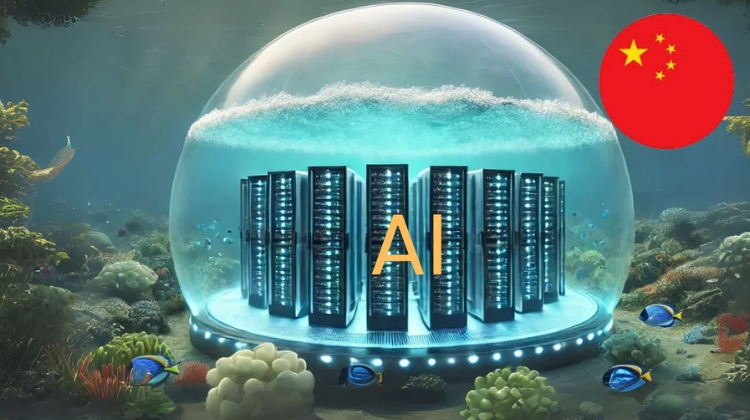
This futuristic data center operates beneath the ocean’s surface, using the natural cooling power of seawater to manage server temperatures efficiently. As incredible as it sounds, this project is already operational and transforming the way data is processed and stored.
According to China’s CGTN, the underwater facility offers computing power equivalent to *30,000 high-performance PCs. Complex tasks that would traditionally take a year can now be completed in a single second. At the core of this system is **DeepSeek AI, capable of processing **7,000 conversations per second. Housed within an **18-meter-long pressure chamber, over **400 advanced servers* connect directly to onshore terminals, supporting everything from AI model training to industrial simulations and game design.
What makes this facility even more remarkable is its commitment to sustainability. Traditional data centers consume enormous energy, primarily for cooling. This underwater setup leverages the ocean’s natural cold, significantly cutting down energy use. It also draws power from *offshore wind farms, aligning with China’s ambitious carbon-neutrality goals. Developed by **Beijing Highlander Digital Technology Co, the facility achieves an impressive **Power Usage Effectiveness (PUE) of 1.1*, outperforming most traditional data centers.
The center is also reshaping AI innovation. With *10 major companies* already signed on, its processing capabilities are attracting attention across industries. It can process over *4 million high-definition images in just 30 seconds* — the workload of *60,000 conventional computers*. This dramatically speeds up AI projects, making what once took weeks achievable in moments.
Another advantage is its *modular design. Unlike conventional data centers that take years to build, these underwater units can be deployed in **just 90 days*. This flexibility allows rapid scalability, particularly in coastal economic hubs, while conserving valuable land resources.
As AI continues to evolve, initiatives like this position China at the forefront of the global AI race. The future of high-performance, sustainable computing may not be in the cloud — but deep beneath the waves.