
President Zardari Offers Expansion of Defence Collaboration and Production to Qatari Emir
Strengthening Bilateral Relations
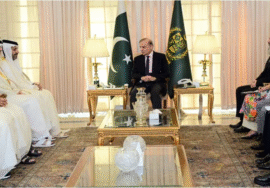
The recent visit of President Asif Ali Zardari to Qatar has proved to be a landmark in the diplomatic and defense relations of Pakistan with the Gulf state. Offering his host, Qatar’s Emir Sheikh Tamim bin Hamad Al Thani, during a meeting in Doha, the President desired an increase in the two countries’ defense collaboration, with particular emphasis on joint defense production and technology exchange. It comes within renewed efforts by Pakistan to deepen strategic partnerships with friendly nations, in particular in the Gulf region, and to turn long-standing defense cooperation into more practical industrial ventures.
The visit underlined the intent of Pakistan to enhance its economic and defence ties with Qatar. President Zardari appreciated the continuous support given by Qatar in areas of trade, investment, and employment for Pakistani expatriates. The two leaders reiterated a mutual commitment towards enhancing cooperation in various sectors, including security, defence manufacturing, and regional stability.
Background of Pakistan–Qatar Defence Ties
The two countries have enjoyed close defence relations marked by frequent high-level visits, military training, and joint exercises for several decades. Qatar has benefited from Pakistan’s wide-ranging military experience, while at the same time Pakistan remains a strong player in Gulf security affairs. From simple training and advisory functions, over the years, the relationship has grown to the level where negotiations are increasingly focused on joint ventures and defence industrial cooperation.
This message of trust and mutual benefit has now developed into a more advanced stage of collaboration-one centered on defence production. Pakistan, with its well-established defence industry, including facilities for manufacturing aircraft, naval systems, and weapons, is offering Qatar a partnership that combines technical expertise with regional accessibility.
Focus on Defence Production and Industrial Cooperation
President Zardari’s proposal to further develop cooperation in joint defense production is a strategic step toward self-reliance and innovation. The Pakistani defense industry is capable of designing, developing, and manufacturing a wide range of military equipment, and cooperation with Qatar could facilitate new opportunities for technological exchange and investment.
The offer is thus very timely for Qatar, which has already been diversifying its defense sources and building local industrial capacity. Joint production projects can help reduce dependence on Western suppliers while simultaneously establishing access to reliable and affordable defense systems in Qatar. This cooperation will give Pakistan an opportunity to attract foreign investment, boost defense exports, and renew its industrial base. This also comes within the larger policy embrace by Pakistan to make defense diplomacy an engine of economic growth.
Economic and Strategic Implications
The proposed expansion in defence collaboration carries significant economic and strategic implications for both nations. Economically, it has the potential to create new employment opportunities, foreign investment, and technology transfer. For Pakistan, it provides an opportunity to utilize its defence industrial potential more gainfully as well as to access wider export markets. Qatar will gain by benefiting from Pakistan’s experience in the skilled workforce and cost-efficient production infrastructure.
The decision makes strategic sense, as it deepens the military partnership between the two major Muslim countries in the emerging security landscape of the region. Closer cooperation between Pakistan and Qatar will go toward cultivating regional stability and increasing the two nations’ standing and sway within international and regional defense forums. It further cements Pakistan’s position as a reliable partner in the Gulf, complementing its close relations with other regional players like Saudi Arabia and the United Arab Emirates.
Regional and Global Context
President Zardari’s outreach to Qatar reflects Pakistan’s broader foreign policy focus on engaging the Gulf states through pragmatic and mutually rewarding partnerships. The Middle East is currently witnessing tectonic shifts in alliances, defense procurement strategies, and industrial collaborations, with an increasing emphasis by countries on acquiring local production and self-sufficiency. In this context, the offer by Pakistan represents a particularly opportunistic moment for establishing the country as a capable and trusted partner for the manufacturing of defense goods.
Moreover, the cooperation bears global relevance: it could potentially serve as a model for South–South cooperation due to Qatar’s increase in regional diplomacy, its economic strength, and Pakistan’s strategic location and defence expertise. It also goes in tune with the emphasis that both countries have placed on peace, dialogue, and development as the basis for security.
Challenges Ahead
While the prospects are promising, joint defence production will demand careful planning and continued coordination. Technology transfer, intellectual property rights, funding, and location of production need to be clearly delineated. On both sides, there will also be the need to handle regulatory frameworks, bringing about complete transparency in the procurement and production processes. Success will also require follow-through at the institutional level. Memoranda of understanding and political commitments will need to be converted into concrete projects, regular working group meetings, and industry-level partnerships. Regular contact between the two defence ministries and industrial sectors will be necessary in order to sustain momentum and make plans a reality.